Two summer camps. Same ad budget. Same channel mix. Similar audiences and seasons.
One fills its sessions weeks before opening day.
The other ends the summer with empty cabins.
If you’ve run summer camp marketing for any length of time, you’ve probably watched this happen. To a competitor. Maybe to your own camp.
The temptation is to chalk it up to luck, brand, or some soft factor no one can really pin down. It’s none of those.
What you’re about to read is a summer camp marketing case study built on real numbers from four recent campaigns. After a decade of running paid acquisition for summer camps across the country, we’ve watched the same pattern repeat hundreds of times. The difference between the camps that win and the camps that don’t isn’t the ad budget. It’s the system the ads are connected to.
By the end, you’ll have a clearer picture of why two camps with identical spending get wildly different outcomes and what to do if you’re tired of being on the wrong side of that gap.
The Real Problem Isn’t Your Leads. It’s Your Systems.
Most camps don’t have a lead problem. They have a systems problem.
Here’s what we mean. A typical camp’s marketing operation looks like this:
- Paid ads run on Meta and Google
- A landing page converts a small percentage of traffic
- A spreadsheet (or CRM, if you’re lucky) collects the leads
- A staff member sends follow-up emails when they have time
- Some leads enroll. Most don’t. Nobody really knows why.
Each piece works in isolation. The ads run. The landing page exists. The leads get collected. But they don’t work together.
The ad targeting doesn’t inform the email follow-up. The follow-up doesn’t feed back into the ad creative. The landing page isn’t built for the specific message the ad is making. The lead source disappears the moment a name is entered into the CRM. Attribution is impossible. Decision-making becomes guesswork.
It’s not a campaign problem. It’s a connection problem. In every summer camp marketing case study where one camp outperforms another with similar resources, this is exactly what we find.
The camps that consistently outperform their peers, sometimes by ten or twenty times, are the ones that have closed those gaps. The campaigns aren’t necessarily smarter. The system around the campaigns is.
That sounds abstract until you look at what it actually produces.
Four Camps, Four Campaigns: A Summer Camp Marketing Case Study
Below are four recent campaigns we’ve run with real camps in partnership with Social Summer Camp. Each had different objectives, different channels, and different starting points. But the same operating principles produced the results.
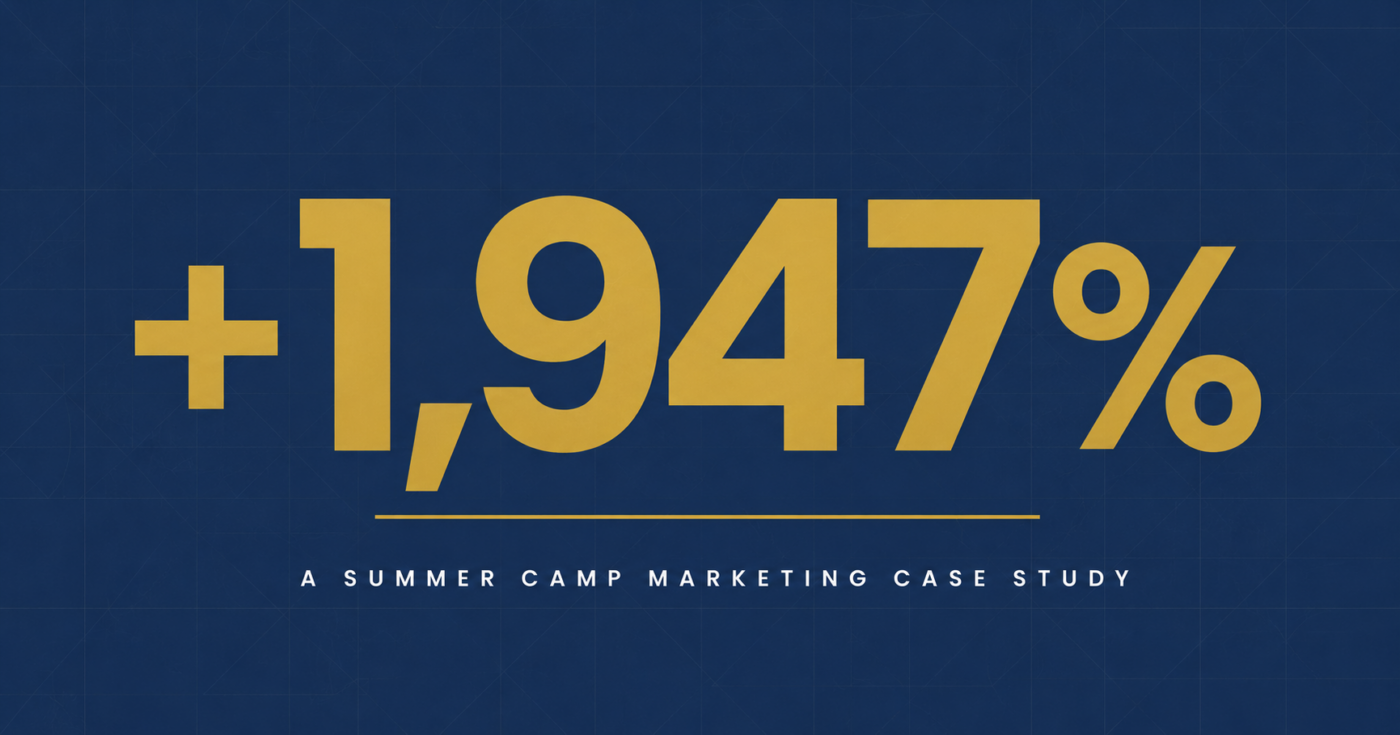
Berkshire Soccer Academy: +1,947% More Landing Page Views
The TeamFirst Adult Women’s Fantasy Soccer Camp ran a Meta ad campaign over the spring 2026 season. The results:
- +1,947% increase in landing page views year-over-year (12,245 views vs. 598 the previous year)
- 9.14% click-through rate
- 67,532 unique accounts reached
- $0.06 cost per click
What’s worth noting isn’t the raw click-through rate, although 9% is excellent for paid social. It’s the +1,947% LPV jump.
Same camp. Similar budget envelope. Twenty times more people are actually visiting the landing page.
What changed wasn’t the ads alone. It was that the entire path, from ad creative to audience targeting to landing page experience, was rebuilt as one connected system. The ads stopped working in isolation. They started feeding a specific action on a specific page designed to reach the specific audience they were targeting.
When the camp ran ads without that connective tissue, they got 598 LPV. With it, they got 12,245.
Med-O-Lark Creative Arts Camp: $1,650 in Ad Spend, 201,000 Impressions
Med-O-Lark is an overnight arts camp in Maine. Over a three-month winter window, the camp invested $1,650 in Meta ads with the goal of brand awareness and lead generation for Summer 2026.
- 201,000 impressions
- 14,157 clicks
- 7.04% click-through rate
- $0.10 cost per click
Most camps see Meta CTRs in the 1-2% range. Med-O-Lark’s was several times that.
The number doesn’t come from one clever ad. It comes from the entire creative-to-audience system being aligned. Strong video creative, designed for the platform. Tight audience targeting informed by what the camp’s enrollment data was already telling them. Routine creative updates that kept the ads from going stale. A brand voice that was consistent across paid, organic, and on-camp messaging.
It’s not one thing. It’s the absence of any one weak link.
Camp Kennybrook: 90 Leads From Google Ads
Camp Kennybrook ran Google Ads over a ten-month span starting in late summer 2025.
- 5,730 clicks
- 74,576 impressions
- 7.68% click-through rate (above category average)
- $1.86 cost per click
- 90 qualified leads generated
Ninety leads from Google Ads, at an efficient CPC, with a CTR above the category average.
What made this work wasn’t the bidding strategy in isolation. It was that the keyword strategy was built from a deep understanding of what camp-shopping families were actually searching for at different points in the year. The ad copy mirrored their language. The landing pages mirrored the ad copy. The form was short. The follow-up sequence was set up before the first lead hit it.
By the time a parent clicked a Kennybrook ad in November, the camp wasn’t sending them into a generic web experience. They were entering a connected sequence designed to move them from “casually looking” to “registered for a summer session.”
Academy Camps: 70 Leads at $0.97 Cost Per Click
Academy Camps ran a similar Google Ads program over seven months in late 2025 and early 2026.
- 28,310 clicks
- 403,000 impressions
- 7.02% click-through rate
- $0.97 cost per click
- 70 qualified leads generated
The numbers worth dwelling on are the $0.97 CPC and the 28,310 clicks. Most camps fight to keep CPCs under $3 to $4 for competitive keywords. Academy Camps did it for under a dollar while pulling 28,000 clicks.
That kind of efficiency at that kind of scale doesn’t come from being lucky with auctions. It comes from feeding back data from every campaign into the next one. Better keywords. Better negatives. Better landing-page-to-ad alignment. Better quality scores. Every cycle is faster and cheaper than the one before, because the system gets smarter as it runs
What Ties These Four Case Studies Together?
Look at those four summer camp marketing case studies side by side. Different camps. Different platforms. Different objectives.
But every one of them produced strong outcomes for the same reason: nothing in the campaign was operating alone.
The ad creative was informed by the audience data. The audience data was informed by the enrollment outcomes. The enrollment outcomes were informed by the lead source. The lead source was tracked back into the ad targeting. Each piece made the next piece better.
That’s the operating model. Not a campaign. Not a tactic. A connected system in which every part is feeding every other part with information. You can see the full system map here if you want to visualize what that actually looks like end to end.
When you have it, $1,650 buys 201,000 impressions. When you don’t, the same $1,650 buys frustration.
Where Most Summer Camp Marketing Goes Wrong
Every summer camp marketing case study we’ve examined points back to the same diagnostic. If you’re reading this and wondering whether your camp’s marketing is operating as a system or a pile of disconnected tactics, here’s a quick test. Ask yourself:
- When a lead enters our CRM, do we know which ad they came from? If no, the data path is broken.
- Does our landing page address the specific message in the ad they clicked? If no, the creative-to-conversion path is broken.
- Does our follow-up sequence reflect what we know about that lead’s source? If no, the lead-nurture path is broken.
- Do we know our cost per enrolled camper, not just cost per lead? If no, the attribution path is broken.
- Is our paid strategy informed by what’s working organically, and vice versa? If no, the channel-integration path is broken.
A camp can spend more on ads, and a camp can spend less on ads. Either one can succeed or fail. The variable is almost never the amount. It’s whether the answers to those five questions are yes.
If most of those answers landed in “no,” a structured audit is usually the right first move. Not because more analysis is what’s missing, but because you can’t fix what you can’t see
The Bigger Shift in Summer Camp Marketing
For most of the last decade, the summer camp marketing conversation has been about campaigns. What platforms to run. What creative to make. What audiences to target. Those questions still matter, but they’re table stakes now. Every camp can run a Meta campaign. Every camp can target lookalike audiences.
The conversation that actually distinguishes high-growth camps from struggling ones is no longer about campaigns. It’s about systems. About the operating model that sits underneath the campaigns and makes them compound instead of compete.
This is the work we’ve been doing with Social Summer Camp for the better part of a decade. Now that the partnership is formalized, it’s also the work we’re bringing more directly to other camps that are tired of running campaigns in isolation.
If any of those five diagnostic questions surfaced a “no,” the next step isn’t a bigger ad budget. It’s a connected system.
See What a Connected System Looks Like
We just published the partnership announcement that walks through the connected operating model in detail, including the full system map and the four campaigns featured in this summer camp marketing case study.
If you’ve been wondering what it looks like to move from running campaigns to operating a system, that’s the clearest articulation we’ve put out.
Or, if you’d rather just have a conversation about what your camp’s marketing is missing, you can start there. No pitch, no commitment. Just a look at where your systems connect and where they don’t.